
Inside Fusion’s Remarkable Fuel Cycle
The Fusion Machine that Makes Its Own Fuel
Can you imagine a gasoline engine that makes new gasoline as it runs? As mind bending as that might seem, it’s essentially what a fusion machine will do. Type One Energy’s Infinity Two fusion power plant is designed to “breed” or generate one if its key fuel sources: tritium—a hydrogen isotope.
Most fusion approaches, including Type One Energy’s Infinity Two fusion power plant, use a combination of two hydrogen isotopes: deuterium and tritium. Together, they provide the fuel needed to power the fusion process.
The Type One Energy team recently authored a peer-reviewed article “Observations for a Fusion Tritium Economy” in the Journal of Fusion Science and Technology. The article sheds light on the fusion fuel cycle and helps fusion developers think about tritium breeding in a new way.
An Abundant Fuel Supply
Deuterium, often called “heavy water,” occurs naturally in water. In fact, every cubic meter of seawater contains approximately 33 grams of deuterium. Even with abundant fuel, fusion does not need much; fusion is extremely energy dense—it releases more energy per kilogram of fuel than any other known energy resource.
As a result, only a few grams of fusion fuel are required to sustain power production, highlighting fusion’s remarkable energy density. With deuterium readily available throughout the world’s oceans, there is enough supply to support humanity’s energy needs for billions of years.
The Tritium Challenge
Unlike deuterium, tritium is rare and does not occur naturally in significant quantities. It is also mildly radioactive, requiring specialized handling and management.
Today, significant tritium inventories are produced through the operation of heavy-water fission reactors, where tritium accumulates in the moderator and coolant. This inventory is mainly used in applications such as self-powered lighting, scientific research, neutron generators, and other specialist technologies.
Existing tritium reserves can help support the early growth of the fusion industry. Canada holds one of the world’s largest tritium inventories, accumulated through the operation of its heavy-water reactor fleet. Existing inventories could help support the initial deployment of the fusion industry, but long-term, fusion devices will be able to generate their own tritium supply.
How Fusion Creates Its Own Fuel
A breeder blanket is a key system surrounding the fusion plasma that captures energy from fusion neutrons while simultaneously producing new tritium fuel.
Inside the blanket, lithium atoms interact with neutrons released during the fusion reaction. These interactions generate heat while also producing tritium, effectively replenishing the fuel supply needed for continued operation. This process is known as tritium breeding.
The blanket is also designed to provide shielding—absorbing and managing neutrons before they reach sensitive equipment elsewhere in the fusion device.
As a result, the breeder blanket serves three essential functions:
- Produces new tritium fuel
- Captures thermal energy for power generation
- Shields critical components from neutron damage
Why Lithium Matters
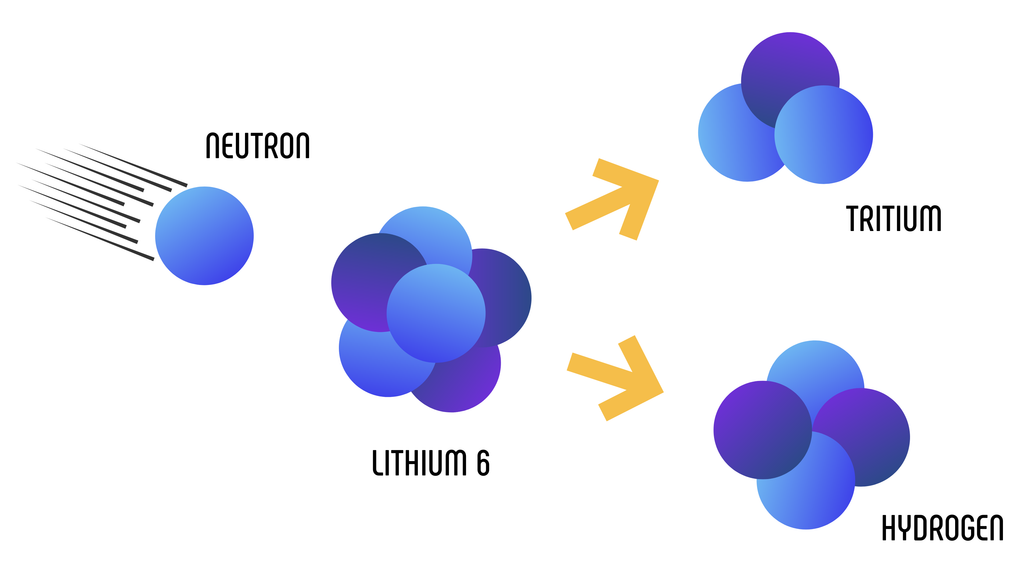
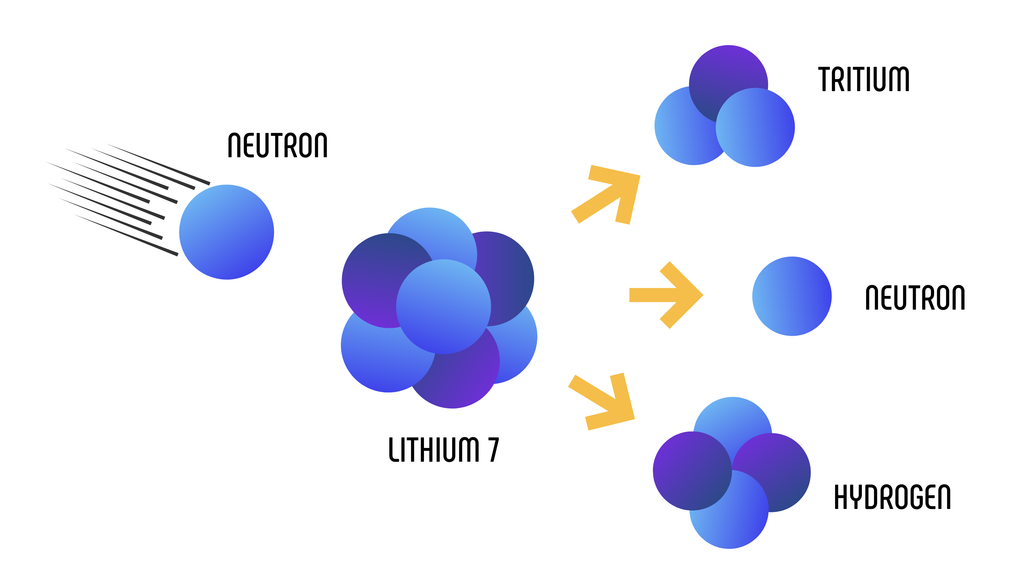
Just as hydrogen has different isotopes, lithium has two primary forms relevant to fusion applications: lithium-6 (Li-6) and lithium-7 (Li-7).
Both lithium isotopes can contribute to tritium production, although through different reactions. When Li-6 absorbs a neutron, it produces tritium and releases energy. Li-7 can also produce tritium through interactions with sufficiently energetic neutrons, and the resulting reaction produces an additional energetic neutron. Engineers can optimize lithium composition and blanket design to achieve the required balance of tritium breeding, neutron economy, and thermal performance.
Rethinking the Future of Fusion Fuel Production
Producing tritium inside a fusion power plant is a complex engineering challenge. Incorporating breeding systems introduces additional design requirements that can affect overall plant performance and efficiency.
In a recent paper titled “Observations for a Fusion Tritium Economy” in the Journal of Fusion Science and Technology, the Type One Energy team explored a different way of thinking about fusion deployment at scale. Rather than assuming every future fusion power plant must support full tritium breeding systems, the paper explores whether future fleets could comprise a mix of breeding and non-breeding plants. Such an approach could allow some fusion plants to prioritize tritium production, while others place greater emphasis on power generation.
By distributing these responsibilities across an interconnected fusion ecosystem, developers could reduce complexity, simplify plant designs, and accelerate deployment.
This perspective becomes increasingly important when considering a future where fusion power plants are being built and commissioned regularly around the world. A diversified approach to fuel production and power generation could help the industry scale more quickly while maintaining a reliable fuel supply for continued growth.
Fusion’s fuel cycle offers an important pathway toward long-term fuel sustainability. With abundant deuterium resources and the ability to generate tritium within the power plant itself, fusion offers a pathway to long-term energy security, helping provide safe, affordable, abundant energy for generations to come.